Disclosure: 8 Sleep Alternative is affiliated with Good Sleep and may earn a commission from some links on this page. That never changes what we write; see our Affiliate Disclosure. Prices below were checked on manufacturer sites in October 2026 and change often.
Active bed cooling comes in two flavors: systems that circulate water through a pad, and systems that blow air under your covers. Both actively remove heat, unlike passive toppers, but they behave differently in real bedrooms. Here is how they work and how to choose.
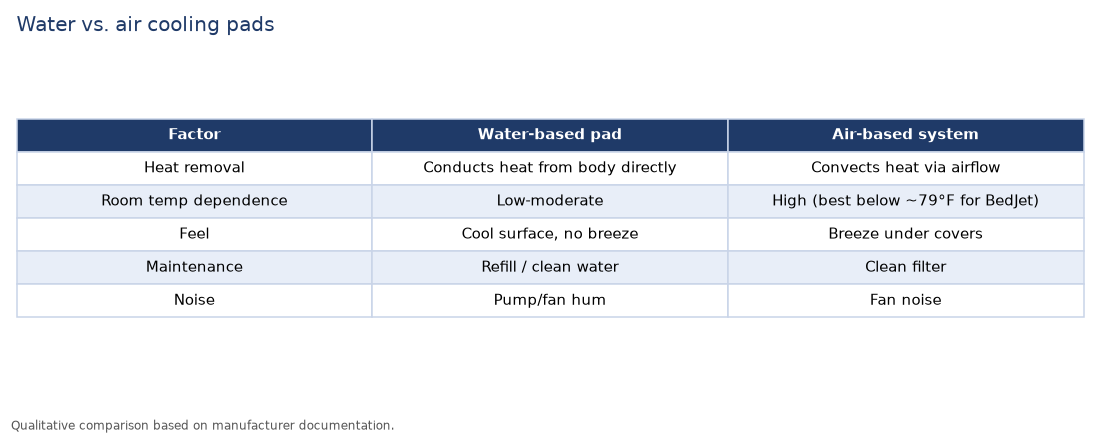
How water-based pads work
A bedside unit cools or heats water to a set temperature and pumps it through thin tubes or channels in a pad on top of your mattress. Heat moves from your body into the cooler water by conduction, the water returns to the unit, the unit removes that heat and the cycle repeats. Examples include Eight Sleep, Sleepme’s ChiliPad and Good Sleep.
Water is far better at absorbing and carrying heat than air, which is why a thin water layer can make a surface feel distinctly cold. Water systems can also hold a steady temperature all night and are less dependent on the air temperature in your room.
How air-based systems work
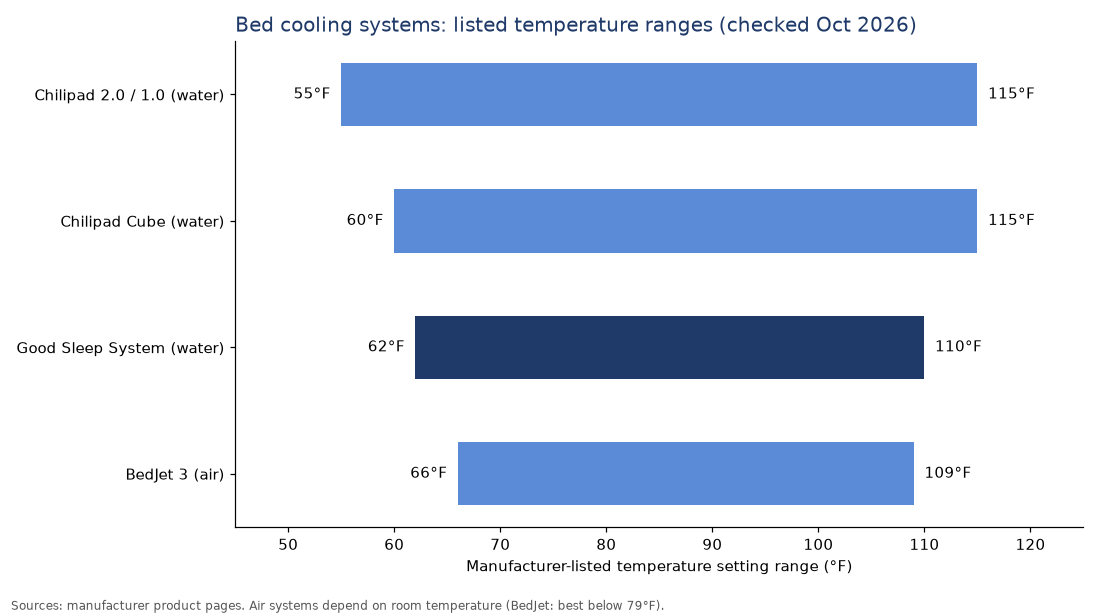
An air system draws in room air, heats or conditions it, and blows it through a hose under your sheets or comforter. The moving air carries away heat and moisture by convection and evaporation. BedJet is the best-known example; its BedJet 3 lists a 66-109°F thermostat range.
Air is excellent at drying sweat and warming a bed quickly. But in cooling mode, an air system is limited by the temperature of the air it pulls in. BedJet says its cooling works best when the bedroom is below 79°F and recommends air conditioning first if the room is regularly hotter.
Head-to-head
| Factor | Water | Air |
|---|---|---|
| Cooling power at the surface | High | Moderate, room-dependent |
| Hot rooms (no A/C) | Better choice | Struggles above ~79°F (BedJet) |
| Sweat drying | Good (cooler skin sweats less) | Excellent (airflow evaporates sweat) |
| Feel | Cool surface, still bedding | Breeze under covers |
| Heating | Yes | Yes, very fast |
| Maintenance | Water top-ups, periodic cleaning | Filter cleaning |
| Typical price (Oct 2026) | $699 (ChiliPad Cube) to $3,000+ | $498-$699 (BedJet 3) |
| Adjustable beds | Check each brand | BedJet: compatible |
When water is the better choice
- Your room is warm and you cannot cool it much.
- You want a consistently cold surface all night.
- You do not like the feel of air moving under your covers.
- You run very hot or have night sweats; see our night sweats guide.
When air is the better choice
- Your bedroom is air-conditioned.
- Budget is a priority.
- You want rapid warming in winter as well as cooling.
- You sweat and want it dried quickly.
- You have an adjustable base.
Water system options
Good Sleep ($1,479): cools to 62°F, heats to 110°F, touch-panel control, no app or subscription, dual-zone on King. ChiliPad 2.0 (from $1,599): 55-115°F, app schedules and remote, no subscription. Eight Sleep Pod (from $2,799 plus Autopilot): smart automation and tracking. Compare them in our comparison, or read Eight Sleep vs ChiliPad.
Air system options
BedJet 3 ($498 sale, regular $699) and the half-bed BedJet 3 Mini ($478 sale). See Eight Sleep vs BedJet.
Safety and practical notes
- Follow manufacturer guidance on water type (often distilled) and cleaning.
- Route hoses so they will not kink or be stepped on.
- Keep the bedside unit ventilated.
- Check the trial and return policy, including restocking fees.
The physics in plain English
Water can absorb a lot more heat than the same volume of air, and it conducts heat much better. That is why stepping into a 70°F pool feels cold while 70°F air feels pleasant. In a bed, a thin layer of cool water right under the sheet pulls heat from your body steadily. Air, by contrast, has to be moved in large volumes to carry the same amount of heat, and it can never get colder than the air it starts with unless the system includes refrigeration. Air’s advantage is evaporation: moving air dries sweat, and evaporation itself is cooling.
Cost over time
Air systems are usually cheaper up front. Water systems cost more but tend to deliver stronger surface cooling. Neither BedJet, ChiliPad nor Good Sleep requires a subscription according to their makers; Eight Sleep requires Autopilot for the first year. Add maintenance supplies and electricity to the total for whichever you choose.
Our take
If your bedroom is air-conditioned and your main complaint is sweatiness, an air system is a cost-effective fix. If your room runs warm, you want a cold surface, or you deal with hot flashes, water cooling is usually worth the higher price. For simple, no-app water cooling, the Good Sleep System is our pick; for the widest range, ChiliPad.
Living with each system
Water: day to day
Expect to top up the reservoir periodically and run a cleaning cycle occasionally using the manufacturer’s recommended solution. The unit makes a soft hum. The bed itself feels like normal bedding with a cool surface. Many owners leave the system on a fixed setting all season.
Air: day to day
Air systems need the hose nozzle positioned under your covers and an occasional filter rinse. You will feel and hear a gentle airflow. Warming mode is a standout: BedJet markets warming the bed much faster than an electric blanket.
Cost comparison
| System | Type | Listed price (Oct 2026) |
|---|---|---|
| BedJet 3 Mini | Air | $478 sale |
| BedJet 3 | Air | $498 sale |
| ChiliPad Cube | Water | From $699 |
| Good Sleep | Water | $1,479 |
| ChiliPad 2.0 | Water | From $1,599 |
| Eight Sleep Pod 5 Core | Water, smart | $2,799-$3,199 + Autopilot |
Testing water vs air in your own bedroom
If you can, measure your bedroom temperature at bedtime and at 3 a.m. for a week before buying. That single number tells you a lot:
- Consistently under about 75°F: an air system like BedJet is likely to perform well and costs less.
- Around 75-79°F: either can work; consider your preference for airflow versus a still, cool surface.
- Often above 79°F: choose water cooling, or improve room cooling first.
Then use the trial period to test on your hottest nights, because that is when the difference between water and air shows up most.
Can you use both?
Some people pair an air system for fast warm-ups and sweat drying with a water system for steady cooling, but for most sleepers that is unnecessary. One active system, breathable bedding and a reasonably cool room cover the vast majority of hot sleepers.
Mistakes when choosing between water and air
- Ignoring room temperature, the single biggest factor for air systems.
- Forgetting the feel. Some people dislike a breeze under the covers; others dislike a cold, still surface.
- Overlooking maintenance. Water systems need refills and cleaning.
- Skipping the trial. Feel preferences are personal.
How we researched this article
We used BedJet’s official specifications and room-temperature guidance, Sleepme’s ChiliPad documentation, Good Sleep’s product page and Eight Sleep’s pricing, all checked in October 2026. We do not invent test results, ratings or quotes, and because we are affiliated with Good Sleep we flag where competitors are stronger.
Noise and sleep quality
Both systems make some sound. Water units run a pump and a fan to shed the heat they collect; air units run a fan that pushes air through the hose. Brands describe their latest models as quiet, and many owners get used to the hum quickly, but light sleepers should place the unit as far from the pillow as the hose allows and test on a silent night during the trial. White noise can mask a steady hum for some people.
Bottom line
Water pads are the stronger choice for hot rooms, very hot sleepers and anyone who wants a consistently cold surface. Air systems are the budget-friendly choice for cool or air-conditioned rooms and are excellent at drying sweat and warming the bed quickly. Measure your room, think about how you want the bed to feel, and choose accordingly.
Frequently Asked Questions
Is water or air cooling better for hot sleepers?
For very hot sleepers and warm rooms, water usually performs better. Air systems work well in cool or air-conditioned rooms.
Do water cooling pads leak?
They are designed as sealed systems, but follow setup instructions and check warranty coverage.
Are air cooling systems noisy?
They use a fan, which makes some noise. BedJet cites acoustic damping. Sensitivity varies.
Which uses less electricity?
It depends on the model and setting. BedJet lists up to 40W in cool mode; heating uses far more. Check each product’s specs.
Can I combine air and water cooling?
Some people do, but for most, one active system plus breathable bedding is enough.
Which is quieter, water or air?
It varies by model. Water units hum from a pump and fan; air units produce fan and airflow sound. Most owners adapt, but light sleepers should test both if possible.
Do water pads feel wet?
No. The water is sealed inside channels; you feel a cool surface, not moisture.
Do air systems make the room colder?
No. They direct air under your covers rather than cooling the room, and in cooling mode they rely on room air.
Which is better for couples?
Both can be set up for two sleepers. Water systems commonly offer dual-zone pads; BedJet uses a dual-zone sheet or two units.
Which lasts longer, water or air systems?
It depends more on build quality and care than on the cooling method. Compare warranty lengths, keep water systems clean and topped up, and rinse air filters as directed to maximize lifespan.
Affiliate Disclosure: This article contains affiliate links. If you purchase through our links, we earn a commission at no extra cost to you. Our editorial recommendations are based on genuine research and are not influenced by commission rates. Read our full disclosure policy.
8Sleep Alternative Editorial Team
Independent researchers focused on temperature-controlled sleep technology. We test products against published sleep science and provide unbiased comparisons for consumers.