Disclosure: 8 Sleep Alternative is affiliated with Good Sleep and may earn a commission from some links on this page. That never changes what we write; see our Affiliate Disclosure. Prices below were checked on manufacturer sites in October 2026 and change often.
A cooling mattress topper is one of the easiest upgrades for a hot bed. But “cooling” means very different things depending on the material. Some toppers simply feel cool to the touch for a few minutes. Others actively pump chilled water under you all night. This guide explains the main types, what they can and cannot do, and how to pick the right one for how hot you sleep.
Why your bed feels hot
Your body releases heat all night, and your core temperature naturally drifts down as you fall asleep. Dense memory foam conforms closely to your body, which reduces airflow and tends to hold that heat near you. Add a warm room, heavy bedding or hormonal changes such as menopause, and the surface you lie on becomes a heat trap. We explain the fixes for foam specifically in how to cool down a memory foam mattress.
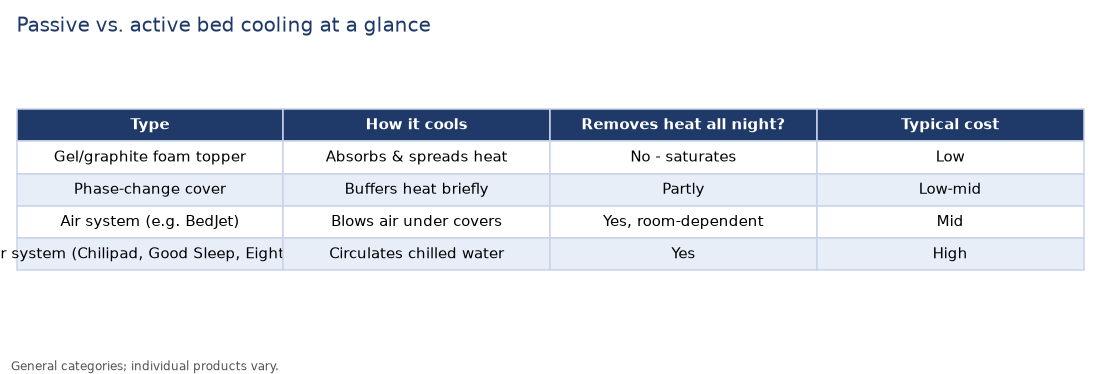
The main types of cooling topper
1. Gel-infused memory foam
Gel beads or swirls are mixed into foam to absorb heat and make the surface feel cooler initially. They are inexpensive and widely available. The limitation is physical: gel can only absorb so much heat before it reaches your temperature. After that, it behaves much like ordinary foam. Good for people who run slightly warm; not enough for night sweats.
2. Copper and graphite infusions
These conductive materials are added to help spread heat away from contact points. In practice, results are similar to gel: a modest improvement, mostly early in the night.
3. Latex
Natural latex is more open and springy than memory foam, and many latex toppers are pin-cored for airflow. It sleeps more neutral than dense foam and is durable. It does not actively cool, but it traps less heat in the first place.
4. Phase-change material (PCM) covers
PCM fabrics absorb heat as they shift state and release it later, which buffers temperature swings. They feel noticeably cool to the touch. Like gel, they have a capacity limit.
5. Active water-cooled toppers
These systems circulate temperature-controlled water through thin channels in a pad, removing heat continuously rather than storing it. This is the category Eight Sleep, ChiliPad and Good Sleep occupy. They cost more but are the only toppers that can hold a set temperature all night. Our water vs air cooling guide explains how they compare with air systems.
Which type should you choose?
| Your situation | Best fit | Why |
|---|---|---|
| Slightly warm, budget-focused | Gel foam or latex topper | Inexpensive, cooler feel, better airflow |
| Memory foam mattress feels stuffy | Latex or PCM cover + breathable sheets | Reduces trapped heat |
| Wake up sweaty most nights | Active water-cooled topper | Removes heat all night |
| Hot flashes / night sweats | Active water-cooled topper, breathable bedding | Consistent, adjustable cooling |
| Couples with different needs | Dual-zone active system | Each side set independently |
Our picks by category
Best active cooling topper for simplicity: Good Sleep System
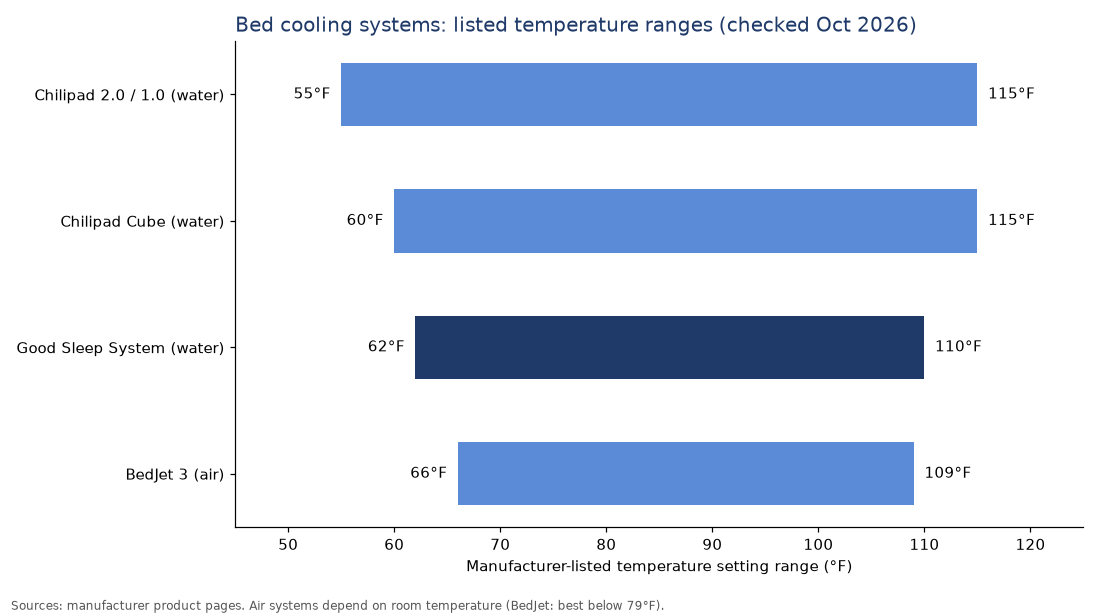
Listed at $1,479 with no subscription, the Good Sleep System lies on top of your existing mattress with elastic corner straps. It cools to 62°F and heats to 110°F, reaches the set temperature in about 15 minutes according to the brand, and uses a touch panel rather than an app. Dual-zone is available on King. Downsides: no sleep tracking, and returns within the 30-night trial carry a 15% restocking fee.
Best for the widest temperature range: ChiliPad 2.0
From $1,599, with a manufacturer-listed 55-115°F range, app schedules, a nightstand remote and no subscription. A good pick if you want very cold sheets or programmable schedules. More in Eight Sleep vs ChiliPad.
Best smart option: Eight Sleep Pod
A cover rather than a loose topper, with sensors, automation and tracking. The most advanced, and the most expensive once Autopilot is included. See our Eight Sleep review.
Best passive option: latex or a quality gel topper
If you only run slightly warm, a breathable latex topper or a reputable gel foam topper is a sensible, affordable first step. Look for open-cell construction, a breathable cover and a trial period.
What to look for when shopping
- Trial and return terms: sleep on it for at least two weeks; check restocking fees.
- Thickness: 2-3 inches changes feel noticeably; thin active pads mostly preserve your mattress feel.
- Cover fabric: breathable covers help any topper.
- Noise (active systems): the bedside unit has a pump and fan.
- Fit: check mattress depth and corner straps or skirt.
- Ongoing costs: subscriptions, cleaning solution, distilled water.
We keep a broader view of every option on our comparison page. If you are comparing covers specifically, see best cooling mattress covers.
Topper vs cover vs pad: what is the difference?
The terms get used interchangeably, but they mean different things. A topper is usually a thicker comfort layer (often 2-4 inches) that changes how your mattress feels. A cover or protector is thin and fits like a fitted sheet; it mostly affects the surface feel and temperature. A pad sits in between and, in the active cooling world, refers to the thin water or air layer that does the cooling. If you like your mattress’s feel, choose a thin cover or active pad. If you want to soften or firm up your bed too, a comfort topper may make more sense, and you can still add breathable sheets on top.
How active toppers fit on your bed
Active water toppers are thin layers that sit between your mattress and fitted sheet, connected by a hose to a bedside unit. Good Sleep uses elastic corner straps; ChiliPad’s pad lies on the mattress; Eight Sleep’s cover fits like a fitted sheet around the mattress. Practical things to check before ordering:
- Mattress depth. Very deep mattresses can make straps or covers fit tightly.
- Hose route. Decide which side of the bed the unit will sit on and make sure the hose reaches without strain.
- Outlet location. The unit needs power near the bed.
- Sheets. Use a fitted sheet deep enough to cover the mattress plus topper.
- Bed frame. Headboards and footboards can affect where hoses run.
With passive toppers, the main fit issue is thickness: a 3-inch topper on a 12-inch mattress needs deep-pocket sheets.
Testing a new cooling topper
Passive and active toppers deserve different tests:
- Passive topper: lie down and note the cool-to-touch feel, then check again after 90 minutes in the same spot. If it feels as warm as your old surface, it is mainly a first-touch effect.
- Active topper: run it at a moderate setting for three nights before going colder, and pay attention to whether you still kick off the covers in the early morning.
- Both: keep the same sheets and room temperature during the test so you are judging the topper, not other changes.
Topper-buying mistakes
- Picking thickness for cooling. A thicker foam topper often sleeps warmer, not cooler.
- Ignoring the cover fabric. A great core under a polyester cover still traps heat.
- Stacking a waterproof protector on a cooling pad. It blocks the cooling you paid for.
- Expecting gel to last all night. It helps early, then saturates.
How we researched this article
We compared material categories using manufacturer documentation and established sleep-product reviews, and used manufacturer pages from Sleepme, Good Sleep, Eight Sleep and BedJet for active-system specs checked in October 2026. We do not invent test results, ratings or quotes, and because we are affiliated with Good Sleep we flag where competitors are stronger.
Caring for a cooling topper
Care affects how cool a topper stays. Foam and latex toppers should be kept in a breathable cover and aired out when you change sheets; trapped moisture makes any topper feel warmer and can lead to odors. PCM covers should be washed according to the label, since harsh detergents and high heat can reduce their effect over time. Active water toppers need the reservoir topped up and occasional cleaning cycles with the brand’s recommended cleaner, plus a check that hoses are not kinked under the bed frame. A well-maintained topper performs closer to how it did on night one.
Our bottom line
If you run mildly warm, a breathable latex or PCM topper is a cost-effective upgrade. If you wake up hot or sweaty, skip straight to an active water topper, because passive materials simply cannot keep up with your body heat for a full night.
Frequently Asked Questions
Do cooling mattress toppers really work?
Passive toppers make the surface feel cooler and can reduce trapped heat, but they cannot remove heat all night. Active water or air systems can. See our full answer in do cooling mattress pads work.
What is the coolest mattress topper material?
Among passive materials, latex and PCM fabrics tend to sleep coolest. For real temperature control, an active water-cooled topper is in a different league.
How thick should a cooling topper be?
Two to three inches is typical for comfort toppers. Active cooling pads are thin and designed to preserve your mattress feel.
Can a topper fix a hot memory foam mattress?
It can help a lot, especially combined with breathable sheets and a cooler room. Active toppers solve it most completely.
Are water-cooled toppers worth the price?
For people who wake up hot or sweaty regularly, many find them worth it. If you only run slightly warm, start with passive options.
Affiliate Disclosure: This article contains affiliate links. If you purchase through our links, we earn a commission at no extra cost to you. Our editorial recommendations are based on genuine research and are not influenced by commission rates. Read our full disclosure policy.
8Sleep Alternative Editorial Team
Independent researchers focused on temperature-controlled sleep technology. We test products against published sleep science and provide unbiased comparisons for consumers.