Disclosure: 8 Sleep Alternative is affiliated with Good Sleep and may earn a commission from some links on this page. That never changes what we write; see our Affiliate Disclosure. Prices below were checked on manufacturer sites in October 2026 and change often.
Memory foam is loved for pressure relief, but it has a reputation for sleeping hot. If you bought a foam mattress and now wake up warm, you do not necessarily need a new bed. Below are practical fixes, from free tweaks to active cooling, roughly in order of cost.
Why memory foam sleeps hot
Traditional memory foam is dense and viscoelastic: it softens with body heat and molds closely around you. That contouring is what makes it comfortable, but it also reduces the air gap between your body and the mattress and limits airflow through the material. Heat you release has nowhere to go, so it builds up around you. Many newer foams use open-cell structures, gel or other infusions to reduce this, but even “cooling” foam can feel warm on hot nights.
Free and low-cost fixes
1. Lower the room temperature
Start here. Aim for roughly 60-67°F. Our ideal bedroom temperature guide explains why.
2. Swap your sheets
Polyester and microfiber trap heat and moisture. Linen, cotton percale and lyocell (Tencel) are far more breathable. This single change makes a noticeable difference for many people.
3. Remove or replace a non-breathable protector
A plastic-backed waterproof protector can turn your bed into a sauna. If you need protection, look for thin, breathable versions.
4. Use a lighter comforter
A heavy duvet on top of a heat-trapping mattress compounds the problem. Try a lightweight quilt or a breathable blanket and add layers only if needed.
5. Improve airflow under the mattress
Solid platforms and mattresses directly on the floor restrict airflow. A slatted base allows heat and moisture to escape from below. Follow your mattress warranty’s foundation requirements.
6. Point a fan at the bed
A fan moving air across the bed improves evaporation and helps carry heat away from the surface.
7. Pre-cool the bed
Leave the bedding pulled back during the evening so the mattress is not trapping daytime heat, and keep blinds closed on sunny days.
Mid-cost fixes
8. Add a breathable topper
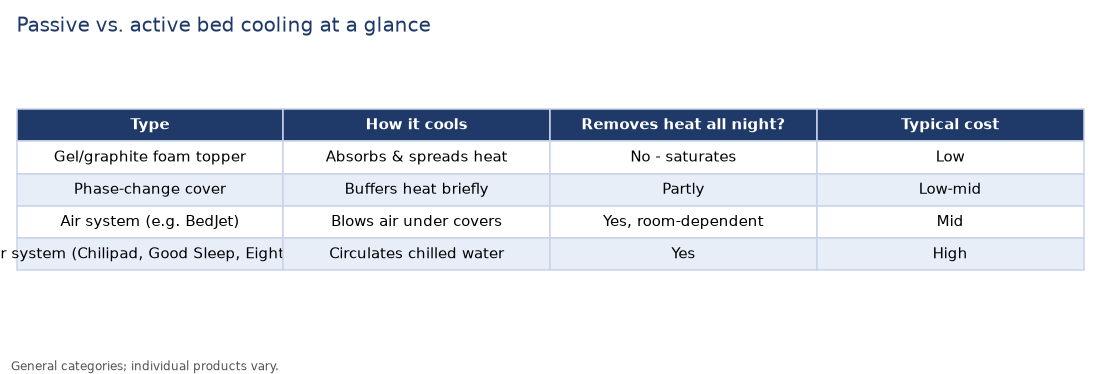
A latex topper or a PCM (phase-change) cover over memory foam adds a less heat-retaining layer between you and the foam. Pin-cored latex in particular sleeps more neutral. See best cooling mattress toppers and best cooling mattress covers.
9. Choose a cooling pillow
Your head and neck release a lot of heat. A breathable pillow helps; see best cooling pillow.
10. Sleep on top, not in
Softer foam lets you sink deeper, increasing contact. A slightly firmer topper or comfort layer reduces how much the foam wraps around you.
Active fixes (most effective)
11. An air-based system
BedJet 3 ($498 on sale in October 2026) blows temperature-controlled air under your covers and is very good at drying sweat. It works best in rooms below about 79°F, according to BedJet.
12. A water-cooled topper
For memory foam, a water-cooled topper is the most complete fix because it removes heat right at the surface, all night. the Good Sleep System lies over your existing mattress, cools to 62°F and needs no app or subscription ($1,479). ChiliPad 2.0 (from $1,599) and Eight Sleep (from $2,799 plus Autopilot) are the other main options. Compare them in our comparison and read water vs air cooling.
Which fixes should you try first?
| If you… | Try |
|---|---|
| Run slightly warm | Fixes 1-4 |
| Feel stuck in the foam | Fixes 8 and 10 |
| Wake up sweaty | Fixes 2, 3 and 11 or 12 |
| Have hot flashes or night sweats | Fix 12 plus breathable bedding |
| Share the bed with a cold partner | A dual-zone active system |
Does new foam sleep hotter?
New memory foam can feel firmer and sometimes warmer until it breaks in over the first few weeks. Some people also notice an initial smell (off-gassing) that fades. Give a new mattress time and ventilation before deciding it is hopeless, and apply the low-cost fixes above in the meantime.
When to consider a different mattress
If your mattress is old, sagging or simply too soft, you may be sinking deeper than you should, which increases heat and reduces support. Hybrid mattresses with coil cores tend to sleep cooler than all-foam designs because air can move through the springs. If you are replacing anyway, that is worth considering. Otherwise, a water-cooled topper is the most effective way to keep the mattress you already own.
Comparing the active options for foam
| BedJet 3 | Good Sleep | ChiliPad 2.0 | |
|---|---|---|---|
| Method | Air under covers | Water topper | Water pad |
| Listed price (Oct 2026) | $498 sale | $1,479 | From $1,599 |
| Best room | Under ~79°F | Any typical room | Any typical room |
| App needed | Optional | No app | Optional |
| Subscription | None | None | None |
On foam, water-based pads have an advantage because they cool the exact surface that traps heat. Air systems are cheaper and very good at drying sweat if your room is already cool.
Keeping your foam mattress fresh
Heat and sweat go together. Use a breathable, washable protector, wash sheets weekly, and air the mattress out occasionally by stripping the bed for a few hours. A fresher mattress tends to feel cooler and more comfortable.
A 7-night plan to cool your foam mattress
Rather than buying everything at once, layer the fixes and see what works:
- Night 1: lower the room to about 65°F and switch to a light quilt.
- Night 2: swap to linen or percale sheets and remove any plastic-backed protector.
- Night 3: add a fan across the bed.
- Nights 4-5: pull back the bedding during the evening to air out the mattress.
- Nights 6-7: assess. Still waking up hot? Move on to a breathable topper or an active cooling pad.
Most people find that the first three changes help noticeably. If you still overheat after a week of all of them, the foam itself is the bottleneck, and only active cooling will fully solve it.
Memory foam on an adjustable base
Many foam mattresses sit on adjustable bases. If yours does, check compatibility before buying an active system: BedJet says it works with adjustable beds, and water-based pads vary by brand, so read each model’s FAQ before ordering.
Mistakes that make foam sleep even hotter
- Adding a thick memory foam topper to a foam mattress.
- Using a solid platform with no airflow.
- Heavy fleece or flannel sheets outside of winter.
- Ignoring the pillow, which can be the warmest thing in the bed.
How we researched this article
We used general materials information on viscoelastic foam, mattress manufacturer guidance, and official specs from BedJet, Sleepme, Eight Sleep and Good Sleep checked in October 2026. We do not invent test results, ratings or quotes, and because we are affiliated with Good Sleep we flag where competitors are stronger.
How much difference to expect
Set realistic expectations for each tier of fix. Bedding and room changes usually make a foam mattress feel less stuffy and reduce how often you wake up warm, especially in the first half of the night. Breathable toppers and covers add a modest further improvement by reducing how much foam wraps around you. Active systems are the only fixes that change the temperature of the sleep surface itself and hold it there, which is why they make the biggest difference for people who still overheat after everything else.
Bottom line
Start free, then cheap, then active. Most people can make a memory foam mattress noticeably cooler without replacing it. If you have tried the low-cost fixes and still wake up hot, a water-cooled topper is the most complete solution for foam.
Frequently Asked Questions
Can you make a memory foam mattress cooler without buying anything?
Yes. Lower the room temperature, use lighter bedding, improve airflow under the mattress and run a fan. These help most for mild heat.
Does a topper make memory foam cooler?
A breathable latex or PCM topper can reduce trapped heat. A water-cooled topper actively removes heat and is the most effective.
Is gel memory foam cooler?
Gel can make foam feel cooler at first, but it saturates with heat. It helps modestly.
Should I replace my memory foam mattress if it sleeps hot?
Not necessarily. A cooling topper and bedding changes often solve the problem for less than a new mattress.
Will a cooling pad change how my mattress feels?
Thin active pads are designed to preserve your mattress feel. Thick comfort toppers change it more.
Does flipping a memory foam mattress help?
Most memory foam mattresses are one-sided and should not be flipped. Rotating head-to-foot can help even out wear, but it will not change temperature much.
Do mattress fans or bed fans help?
Fans that blow air across or under the covers can help with airflow and sweat. They are a low-cost middle step before an active cooling system.
Is a hybrid mattress cooler than memory foam?
Usually, because air moves through the coil layer. If you are replacing your mattress anyway, a hybrid is worth considering for hot sleepers.
Can I put an active cooling pad on a very soft foam mattress?
Generally yes, but check the brand’s guidance. Very soft foam can let you sink, so a thin active pad works best on a mattress that already supports you well.
What is the single best fix for a hot foam mattress?
For persistent overheating, a water-cooled topper is the most effective single fix because it removes heat right at the surface. For mild warmth, breathable sheets and a cooler room often do the job.
Affiliate Disclosure: This article contains affiliate links. If you purchase through our links, we earn a commission at no extra cost to you. Our editorial recommendations are based on genuine research and are not influenced by commission rates. Read our full disclosure policy.
8Sleep Alternative Editorial Team
Independent researchers focused on temperature-controlled sleep technology. We test products against published sleep science and provide unbiased comparisons for consumers.