Disclosure: 8 Sleep Alternative is affiliated with Good Sleep and may earn a commission from some links on this page. That never changes what we write; see our Affiliate Disclosure. Prices below were checked on manufacturer sites in October 2026 and change often.
“Cooling” is printed on a huge number of mattress pads, toppers and protectors. Some of them make a real difference; some feel cool for five minutes and then sleep like any other pad. The honest answer to “do cooling mattress pads work?” is: it depends on whether the pad is passive or active, and on how hot you sleep. This article explains the difference so you can buy the right thing the first time.
Why temperature matters for sleep
Your core body temperature follows a daily rhythm. It begins to fall in the evening, which helps you fall asleep, and reaches its low point in the early morning hours. To shed that heat, your body releases warmth through your skin, especially hands, feet and back. A warm mattress and heavy bedding work against this process, which is why hot sleepers wake up more and feel less rested.
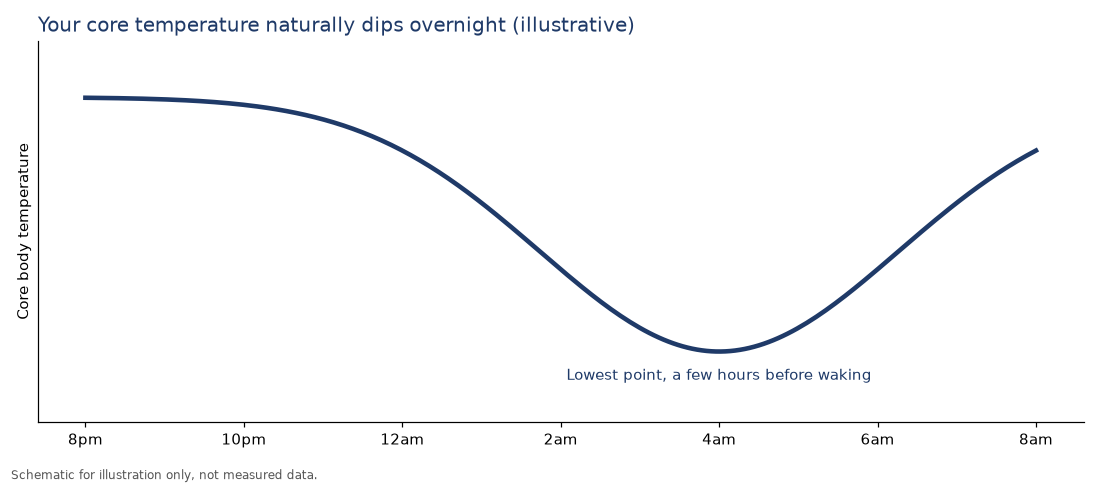
That is the theory behind every cooling product: help your body lose heat at the surface you are lying on. Our ideal bedroom temperature guide covers the room side of the equation.
Passive cooling pads: what they can do
Passive pads use materials such as gel, phase-change fabrics, graphite, copper, latex or breathable fibers. They work in three ways:
- Cool-to-touch feel: fabrics that conduct heat away from your skin feel cooler at first contact.
- Heat buffering: gel and phase-change materials absorb some heat before warming up.
- Better airflow: open-cell foams and latex trap less heat than dense memory foam.
What they cannot do is remove heat continuously. Once the material reaches your skin temperature, it stops pulling heat away. So passive pads tend to help most when falling asleep and for people who run only mildly warm.
Verdict on passive pads
They work modestly. If your bed is “a bit warm,” a breathable pad plus better sheets can be enough. If you wake up sweaty, they usually are not.
Active cooling pads: what they can do
Active systems move heat out of the bed using water or air:
- Water-based (Eight Sleep, ChiliPad, Good Sleep): chilled water circulates through channels under your sheet and carries heat to a bedside unit.
- Air-based (BedJet): a fan unit blows temperature-controlled air under your covers.
Because they keep removing heat, active pads can hold a set temperature all night. That is the key difference. Water systems pull heat directly from the surface; air systems work best when the room itself is reasonably cool (BedJet cites 79°F as its limit for best cooling). Compare the two in water vs air cooling mattress pads.
Verdict on active pads
They work well for hot sleepers, couples with different temperature needs and people dealing with night sweats or hot flashes. The trade-offs are price, a bedside unit with some noise, and a bit of maintenance.
Quick comparison
| Passive pad | Active water pad | Active air system | |
|---|---|---|---|
| Removes heat all night | No | Yes | Yes (room-dependent) |
| Adjustable temperature | No | Yes | Yes |
| Typical price | Low | High ($699-$3,000+) | Mid ($498-$699 for BedJet 3) |
| Noise | None | Low hum | Fan noise |
| Maintenance | Wash cover | Water top-ups, cleaning | Filter cleaning |
Who benefits most from a cooling pad?
- People who wake up hot after the first few hours: active pads help most.
- People in menopause or perimenopause with hot flashes: active cooling and breathable bedding; our sister site Menopause Solved covers symptoms in depth.
- Memory foam owners: see how to cool down a memory foam mattress.
- Couples: a dual-zone active system ends thermostat wars.
Signs a passive pad is not enough
- You kick off covers and wake up between 2 and 4 a.m.
- Your sheets are damp in the morning.
- You have tried breathable sheets and a cooler room without much change.
- You need to cool your side but your partner does not.
If those sound familiar, an active system will likely make a much bigger difference. Our best cooling mattress topper guide covers both categories, and the comparison page lays out the active options side by side.
Getting the most from any cooling pad
- Use breathable sheets (linen, percale or lyocell). A thick, synthetic sheet blocks the pad.
- Skip heavy waterproof protectors over an active pad unless the brand approves.
- Keep the room cool and dark.
- Give it at least a week; your sense of “normal” adjusts.
What independent research says
Research on sleep and temperature consistently shows that thermal comfort affects sleep, and that heat in the bedroom tends to increase wakefulness. Studies on specific consumer cooling products are more limited, and many of the most impressive numbers you will see in marketing come from manufacturer-funded studies. That does not mean the products do not work, only that you should treat headline claims as promising rather than proven. The best evidence for you will be your own two-week trial.
Cooling pads for specific situations
Couples
A single passive pad cools both sides equally, which does not help if one partner runs cold. Dual-zone active systems such as Good Sleep King, dual-zone ChiliPad and Eight Sleep let each person choose.
Hot climates without A/C
Passive pads have little to work with when the room is hot. Water-based active pads are the most effective choice here, since air systems pull in warm room air.
Menopause
Hot flashes come in waves, so an adjustable active system is more helpful than a fixed passive pad. Pair it with breathable bedding and see Menopause Solved for medical guidance.
Adjustable beds
Check compatibility. BedJet says it works with adjustable beds; for water pads, read the brand’s FAQ.
A simple at-home test: is your pad working?
You do not need lab equipment to judge a cooling pad. Over one week, track three things each morning in a notes app:
- Wake-ups: how many times you woke up and whether you felt hot when you did.
- Sheet dampness: dry, slightly damp or soaked.
- Morning energy: a 1-5 rating.
Do the same for a week before the pad arrives if you can. If the numbers do not move after two weeks with a passive pad, that is your answer, and an active system is the logical next step. If you already have an active pad, try lowering the setting two degrees before giving up on it.
Who probably does not need a cooling pad
If you only feel warm in the first few minutes of getting into bed, or only during a few summer weeks, a cooling pad may be overkill. Breathable sheets, a lighter blanket and a fan may be all you need. Save active systems for persistent overheating.
Reasons a cooling pad seems not to work
- It is under a thick protector or mattress pad. Remove insulating layers between you and the cooling surface.
- The room is very hot. Passive pads and air systems both struggle in hot rooms.
- The setting is too warm. On active pads, people often start too conservatively.
- Synthetic sheets. Polyester sheets trap heat and moisture right above the pad.
How we researched this article
We drew on manufacturer documentation for passive and active products, BedJet’s published room-temperature guidance, and general sleep-science sources on thermoregulation; product specs were checked in October 2026. We do not invent test results, ratings or quotes, and because we are affiliated with Good Sleep we flag where competitors are stronger.
The bottom line
Cooling mattress pads do work, within limits. Passive pads make a bed feel cooler and less stuffy, which is enough for many mildly warm sleepers. Active pads remove heat continuously and are the only kind that can keep a hot sleeper cool through the second half of the night. Match the product to the size of your problem: start cheap if you are a little warm, and go active if you routinely wake up hot or damp. Either way, breathable sheets and a cooler room multiply the effect of whatever pad you choose.
For side-by-side specs of the active systems, see our comparison page.
Frequently Asked Questions
Do cooling mattress pads actually lower your temperature?
Passive pads mainly feel cooler and reduce trapped heat. Active pads with water or air actually remove heat and can hold a set temperature.
How long does a gel cooling pad stay cool?
Gel absorbs heat until it reaches your skin temperature, often well before morning. It then behaves like regular foam.
Are cooling mattress pads worth it for night sweats?
Active systems are usually worth considering for frequent night sweats. Passive pads alone often are not enough.
Do cooling pads work on memory foam?
Yes. Memory foam traps heat, so cooling pads can make a noticeable difference, especially active ones.
Is a cooling pad better than lowering the thermostat?
They work together. A cooling pad targets your sleep surface; a cooler room helps your whole body. Active pads let you cool your bed without cooling the entire house.
How long does it take to notice a difference?
With an active pad, most people notice a cooler surface on the first night, but it can take a week to dial in the best setting. Passive pads feel cooler immediately, then settle into a modest, steady effect.
Do cooling pads work in winter?
Many active systems also heat, so they stay useful year-round. Passive cooling pads can feel slightly chilly in winter, which some people solve with a warmer top layer.
Are cooling mattress pads safe for everyday use?
Products sold for bedroom use are designed for nightly use. Follow the manufacturer’s setup, cleaning and electrical guidance, keep hoses and cords tidy, and check the warranty terms before buying.
Affiliate Disclosure: This article contains affiliate links. If you purchase through our links, we earn a commission at no extra cost to you. Our editorial recommendations are based on genuine research and are not influenced by commission rates. Read our full disclosure policy.
8Sleep Alternative Editorial Team
Independent researchers focused on temperature-controlled sleep technology. We test products against published sleep science and provide unbiased comparisons for consumers.